I probably picked up this ex-library book from the JCPL at their whale of used book sale. The full title is The Unknown Universe: A New Exploration of Time, Space, and Modern Cosmology.
I found the writing to be comprehensible to people with a sciencey background, but one does not need a science background to understand much of the material. I was worried it was going to be a little boring — covering too much of the basics, but he added in new details and comments about people and concepts that I had not encountered before.
Page 31. This quote is interesting by Georg Busch. Comets are “‘formed by the ascension from Earth of human sins and wickedness, making a sort of gas which was then set on fire by the anger of God. This poisonous stuff’, he added, ‘falls down on people’s heads, and causes all kinds of unpleasant phenomena, such as diseases, sudden death, bad weather and Frenchmen.” (The translation in the book is slightly different from what came from that website.)
The second sticky note was page 159. Another thing caught my attention. Inertial mass and gravitational mass appear identical. He said that “this is the most mystifying thing in the whole universe.” I had not ever considered the fact that inertial mass might be different from gravitational mass. I just assumed they were the same, since they are defined to have the same value, thus considered to be equivalent.
Page 218-219. Georges Lemaitre beat Hubble in finding the expansion of the universe. He wrote in 1927 the following.
(PDF link) “Un Univers homogène de masse constante et de rayon croissant rendant compte de la vitesse radiale des nébuleuses extra-galactiques“. Annales de la Société Scientifique de Bruxelles. A (in French). 47: 49–59. 1927a. Four years later, it was translated as: “A Homogeneous Universe of Constant Mass and Increasing Radius Accounting for the Radial Velocity of Extra-galactic Nebulae”. Monthly Notices of the Royal Astronomical Society. 91 (5): 483–490. 1931. (These cites were grabbed from https://en.wikipedia.org/wiki/Georges_Lema%C3%AEtre.) When it was translated, they made it seem like this was confirming the Hubble data since they left out some information, but this 1927 article should have been found and read by others before Hubble got famous for his research of 1929.
Page 221. Einstein was supposed to have said for the first time “God does not play with dice” (or something like that) at the Solvay conference of 1927. The author noted that Neils Bohr replied with “Einstein, stop telling God what to do.”
Page 223. In 1924, a Swedish astronomer named Knut Lundmark had estimated the expansion rate of the universe, and this was three years before Lemaitre, and five years before Hubble. It is now about 1% off of the mark. He was much more accurate than both Hubble and Lemaitre, but he has not gotten the accolades for it.
Page 244. The half-life of a proton is something like 1.29 x 10^34 years. It might be now 1.67 x 10^34 years. No citation was given, but the Wikipedia page seems to cover it good enough.
Page 258. Thomas Buchert has a theory of inhomogeneous cosmology that does not need dark energy to explain the supposed acceleration of the expansion of the universe. In 2016, he said that dark energy will be gone by 2026, but I am not sure that will be the case. Instead of treating the whole universe as having an average density, voids and strands of galaxies (and clusters) are considered to have different average densities. This changes the calculations for supernovae distances.
Page 259. David Wiltshire. Universe as a timescape. From that same Wikipedia article on inhomogeneous cosmology, “David Wiltshire proposed a model (timescape cosmology) in which backreactions caused time to run more slowly or, in voids, more quickly, thus leading supernovae observed in 1998 to be thought to be further away than they were.[8][9]” Does time run differently in he voids between the galaxies?
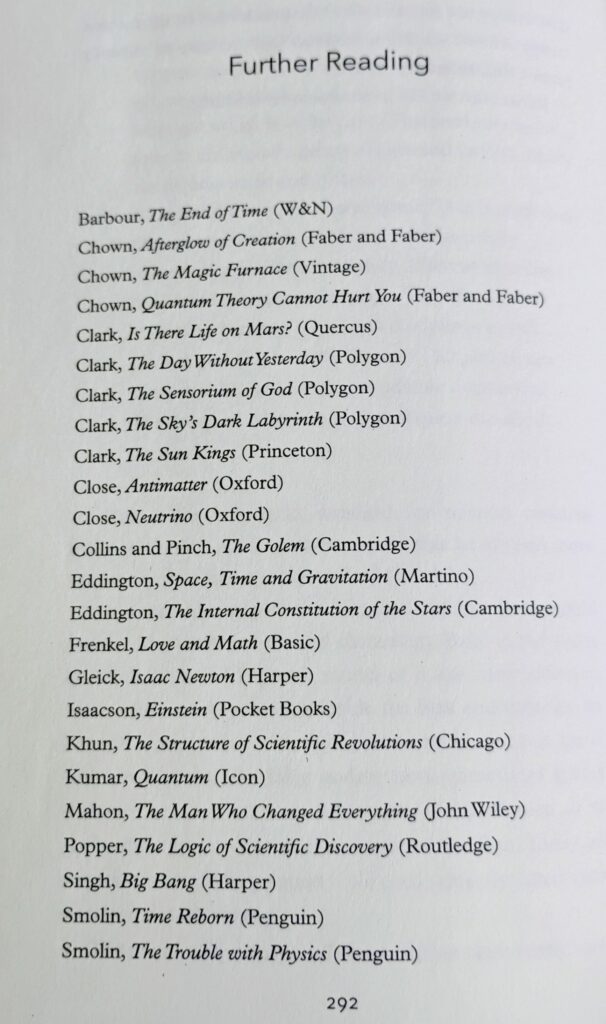
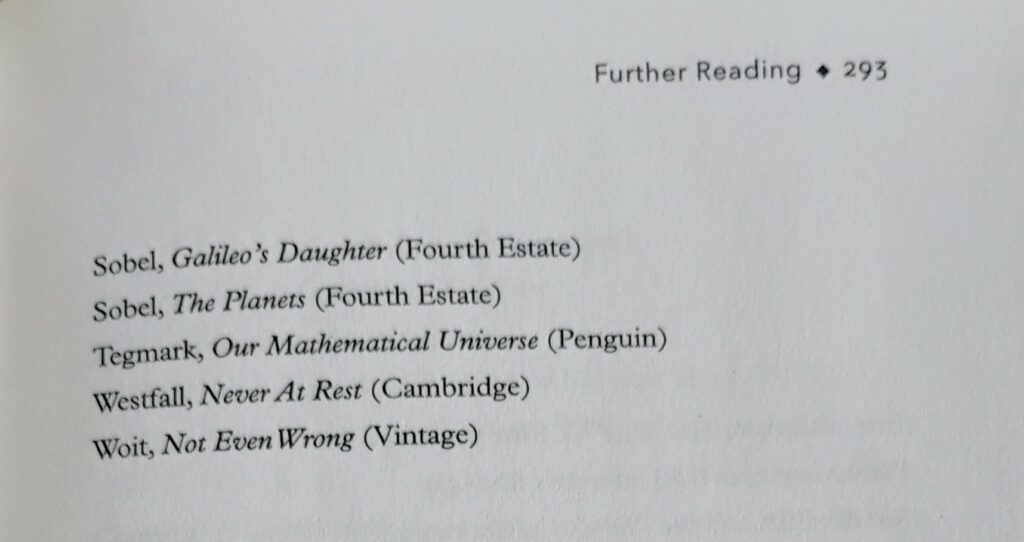
Page 292-293. Here are a bunch of the books that he recommends for further reading. Of course, he recommends 5 of his other books. I might try to read his “The Day without Yesterday” since that was a good chapter in this book. I assume he will go into more detail about the Big Bang.