Monthly Archives: May 2025

Timekeepers — Just Timekeepers

There is an unofficial subtitle to this book by Simon Garfield, how the world became obsessed with time. One can find it on the dust jacket, but it is hard to find and read, since it has blue text with a blue background. A summary says it is an “exploration of the ways we have perceived, contained, and saved time over the last 250 years.” This paragraph can be found at the book website, and some of this text is on page 4 of the book.

“Timekeepers is a book about our obsession with time and our desire to measure it, control it, sell it, film it, perform it, immortalise it and make it meaningful. It has two simple intentions: to tell some illuminating stories, and to ask whether we have all gone completely nuts.”

I had read most of this book several years ago, but I never blogged about it. I figured I should make sure I read the whole thing and blog about it this time, since I like reading about and thinking about the concept of time.

The book has some British terminology that not everyone knows. On page 13, the author goes to the hospital that “had its own routines and schedules. As did the A & E,” where he sat for a long time. What is A & E? I guess it means the Accident & Emergency room.

Page 21. The most commonly used noun in the English language is time. Looks like many other website confirm that.

Page 35. There is a French group called Fonacon that booed the new year in the transition from 2008 to 2009. “’We’re saying no to the tyranny of time, no to the merciless onslaught of the calendar, and yes to staying put in 2008,’ says a man who identifies himself as Marie-Gabriel, a militant member of the Fonacon group, which is organizing its fourth annual anti–New Year protest.”

Page 46. Start discussion of how the railways forced people to coordinate their clocks across the country of England. Page 52-53. On November 18, 1883, the US changed from having 49 time zones to just 4 in the contiguous 48 (or the 38 states in 1883) states.

Page 130. There is an IWC watch that will show the correct moon phase for the next 577 or so years. What happens then? It will be off a day, and you simply have to take it to an IWC boutique shop in the year 2602 (or so) to get it adjusted.

Page 137. This book, Technique and history of the Swiss watch from its beginnings to the present day, is mentioned. There are two editions of it. One from 1953, and one from 1970.

Page 205. There is a watch by Louis Moinet that has a dinosaur bone on the inside.

Page 213. “Although the majority of the [watch] brands were aimed at overachieving men, overachieving women were also welcomed with promotional baloney.”

On page 222, he mentions a supposedly famous slogan that I had never heard. It is “Refreshes the parts other beers cannot reach.” Huh? I guess — “Heineken Refreshes the Parts Other Beers Cannot Reach’ was written by Terry Lovelock in 1973, when he was a copywriter at the Collett Dickenson Pearce ad agency. It was a golden time in British advertising, and CDP was at its peak: led by Frank Lowe the agency set a benchmark for creativity in ads.”

Pages 231-232. There are a bunch of time management book recommendations.

Page 243. If you wish to get up an hour or two earlier to start the day, you will also have to ask your servants to prepare your morning tea and breakfast an hour or two earlier than usual. So says Arnold Bennet in his 1910 book, How to live on twenty-four hours a day.

Page 307. A book by Hartmut Rose was mentioned. Beschleunigung: Die Veränderung der Zeitstrukturen in der Moderne. This roughly translates to [Social] Acceleration: The changing structures of time in modernity. The gist of the book is that “the more apps and computer programmes we download to streamline and order our lives, the more we feel like screaming.”

This passage from pages 316 to 317 hit home. “We struggle our whole lives to make enough money, to give enough love, to get the things we think are important, to do the things we think are important, to right some wrongs, to help others, to advance our understanding of the universe, to advance technology and the ease of living — and if we consider ourselves artists we try to create beauty and truth — and we try to do this all in the narrow time span available to us, and then every 100 years we’re all swept away and another bunch of people try to do the same. Time — and not even geologists deep time, just the time that comes after the time we have now — just keeps on rolling right along.” Yup, life is short, try to make the most of the time you have here in the universe.
Standard Handbook for Telescope Making

I was able to check out the revised 1984 edition of this book by Neale E. Howard. I did not realized that the original edition of the book was from 1959 and it shows. I had not heard of Neale Howard, and I wanted to see how this book compared to some others by Allyn J. Thompson, Jean Texereau, and Albert G. Ingalls.

While the revised edition does include information on some of the telescope companies and part suppliers that appeared between 1959 and 1984 (with addresses but no phone numbers), I found that some/much of the book had not really been updated.

They did include some pages that mentioned the new (at the time) Dobsonian mounts on pages 196-200, but they paid it short shrift. The book starts by assuming that the builder will make an equatorial mount for a 8 inch f/7 telescope so that it can easily track the stars with one motion.

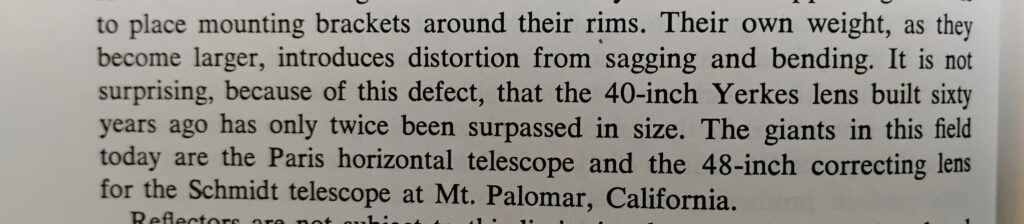
I did not realize that the book came out in 1959 at first. It wasn’t until page 12 when I saw the text that said that the Yerkes Observatory was built sixty years ago. That did not make sense. It was not built in the mid 1920s, it was from the late 1800s. So, in looking at the copyright page, it said it was originally published in 1959. Ah, yeah, now this makes sense.

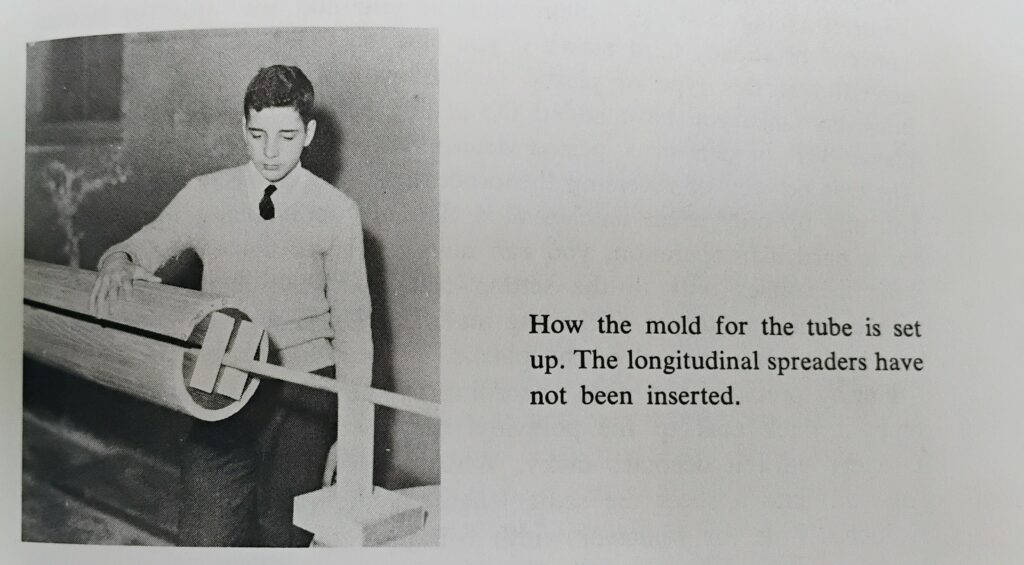
With images like the one below on page 173, it certainly looks like the book came out in 1959. (Sorry, kid, you gotta wear a tie for this photoshoot.)

Thus, some of the book was updated between 1959 and 1984, but not the whole thing.

I would also not recommend following the 18 supposedly simple steps for silvering a mirror as given on pages 333 to 335. That process is probably best left to mirror coating professionals.

However, the advice on how to grind a mirror, how make a pitch lap, and how to polish and figure a mirror had not really changed in the intervening years (and to the year 2025), so that section of the book still seems relevant.

Overall, if you want to grind, polish, and figure your own telescope mirror, then this book might provide some good advice for you.

The Unknown Universe by Stuart Clark

I probably picked up this ex-library book from the JCPL at their whale of used book sale. The full title is The Unknown Universe: A New Exploration of Time, Space, and Modern Cosmology.

I found the writing to be comprehensible to people with a sciencey background, but one does not need a science background to understand much of the material. I was worried it was going to be a little boring — covering too much of the basics, but he added in new details and comments about people and concepts that I had not encountered before.

Page 31. This quote is interesting by Georg Busch. Comets are “‘formed by the ascension from Earth of human sins and wickedness, making a sort of gas which was then set on fire by the anger of God. This poisonous stuff’, he added, ‘falls down on people’s heads, and causes all kinds of unpleasant phenomena, such as diseases, sudden death, bad weather and Frenchmen.” (The translation in the book is slightly different from what came from that website.)

The second sticky note was page 159. Another thing caught my attention. Inertial mass and gravitational mass appear identical. He said that “this is the most mystifying thing in the whole universe.” I had not ever considered the fact that inertial mass might be different from gravitational mass. I just assumed they were the same, since they are defined to have the same value, thus considered to be equivalent.

Page 218-219. Georges Lemaitre beat Hubble in finding the expansion of the universe. He wrote in 1927 the following.

(PDF link) “Un Univers homogène de masse constante et de rayon croissant rendant compte de la vitesse radiale des nébuleuses extra-galactiques“. Annales de la Société Scientifique de Bruxelles. A (in French). 47: 49–59. 1927a. Four years later, it was translated as: “A Homogeneous Universe of Constant Mass and Increasing Radius Accounting for the Radial Velocity of Extra-galactic Nebulae”. Monthly Notices of the Royal Astronomical Society. 91 (5): 483–490. 1931. (These cites were grabbed from https://en.wikipedia.org/wiki/Georges_Lema%C3%AEtre.) When it was translated, they made it seem like this was confirming the Hubble data since they left out some information, but this 1927 article should have been found and read by others before Hubble got famous for his research of 1929.

Page 221. Einstein was supposed to have said for the first time “God does not play with dice” (or something like that) at the Solvay conference of 1927. The author noted that Neils Bohr replied with “Einstein, stop telling God what to do.”

Page 223. In 1924, a Swedish astronomer named Knut Lundmark had estimated the expansion rate of the universe, and this was three years before Lemaitre, and five years before Hubble. It is now about 1% off of the mark. He was much more accurate than both Hubble and Lemaitre, but he has not gotten the accolades for it.

Page 244. The half-life of a proton is something like 1.29 x 10^34 years. It might be now 1.67 x 10^34 years. No citation was given, but the Wikipedia page seems to cover it good enough.

Page 258. Thomas Buchert has a theory of inhomogeneous cosmology that does not need dark energy to explain the supposed acceleration of the expansion of the universe. In 2016, he said that dark energy will be gone by 2026, but I am not sure that will be the case. Instead of treating the whole universe as having an average density, voids and strands of galaxies (and clusters) are considered to have different average densities. This changes the calculations for supernovae distances.

Page 259. David Wiltshire. Universe as a timescape. From that same Wikipedia article on inhomogeneous cosmology, “David Wiltshire proposed a model (timescape cosmology) in which backreactions caused time to run more slowly or, in voids, more quickly, thus leading supernovae observed in 1998 to be thought to be further away than they were.[8][9]” Does time run differently in he voids between the galaxies?

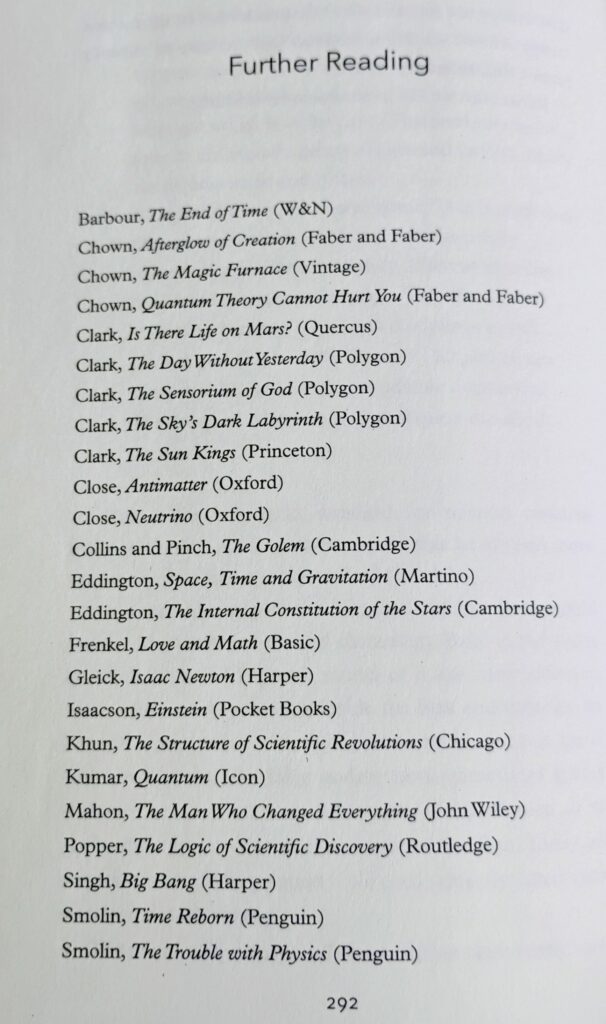
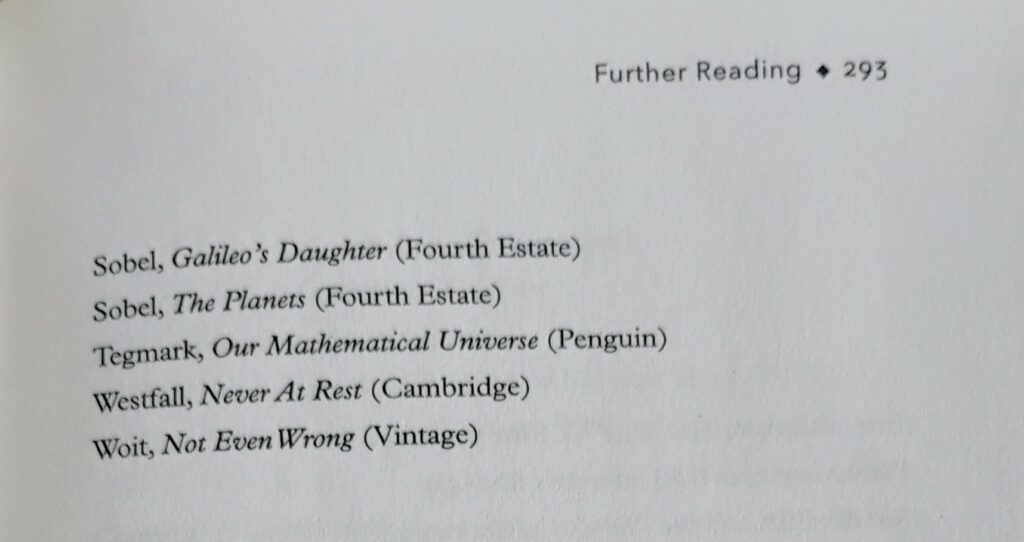
Page 292-293. Here are a bunch of the books that he recommends for further reading. Of course, he recommends 5 of his other books. I might try to read his “The Day without Yesterday” since that was a good chapter in this book. I assume he will go into more detail about the Big Bang.