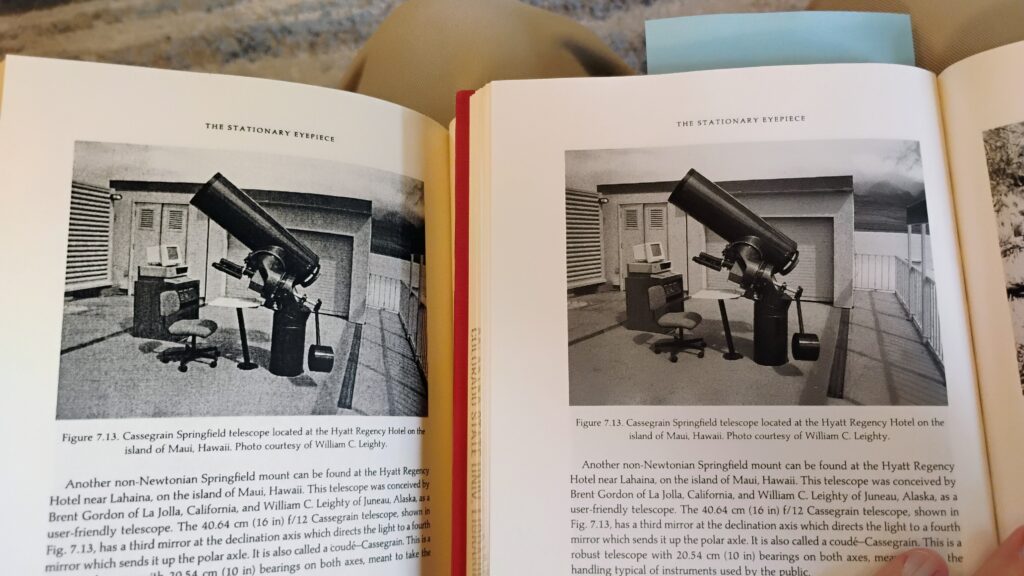
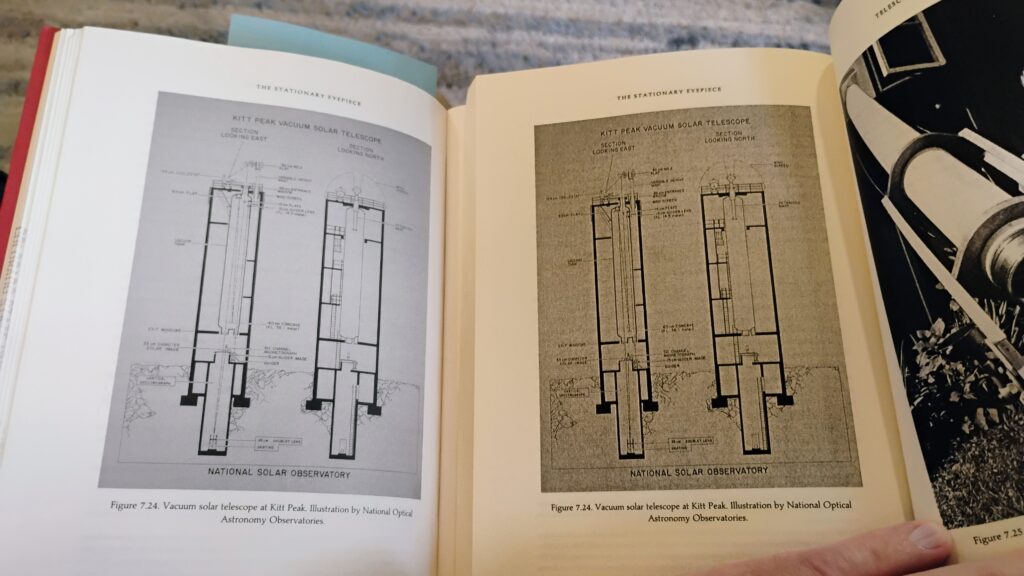
This book came out in 1991, and I bought a reprinted version that came out in 1999. The text is fine and all, but I found the reprinted images lacking. Below are some images that compares the book I bought with the hardback version (with the red cover) that I got from another library.
There were lots and lots of weird and interesting telescopes listed in there. I think they got most of the weird designs as of 1991.
Another negative is the gendered language used by the author. It was odd to see that still used even just 34 years ago. For example, he wrote this sentence on page 195. “This telescope design also supports the maxim that it is the mark of a good engineer to know where he can cut corners but it is the mark of an excellent engineer to know where he must not cut corners.” Are there no female engineers?
Otherwise, the book is ok. If you want to get a copy of the book for yourself, buy the original hardback if you can.
I was able to check out the revised 1984 edition of this book by Neale E. Howard. I did not realized that the original edition of the book was from 1959 and it shows. I had not heard of Neale Howard, and I wanted to see how this book compared to some others by Allyn J. Thompson, Jean Texereau, and Albert G. Ingalls.
While the revised edition does include information on some of the telescope companies and part suppliers that appeared between 1959 and 1984 (with addresses but no phone numbers), I found that some/much of the book had not really been updated.
They did include some pages that mentioned the new (at the time) Dobsonian mounts on pages 196-200, but they paid it short shrift. The book starts by assuming that the builder will make an equatorial mount for a 8 inch f/7 telescope so that it can easily track the stars with one motion.
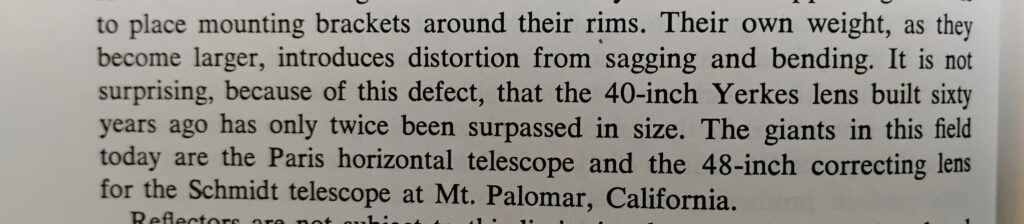
I did not realize that the book came out in 1959 at first. It wasn’t until page 12 when I saw the text that said that the Yerkes Observatory was built sixty years ago. That did not make sense. It was not built in the mid 1920s, it was from the late 1800s. So, in looking at the copyright page, it said it was originally published in 1959. Ah, yeah, now this makes sense.
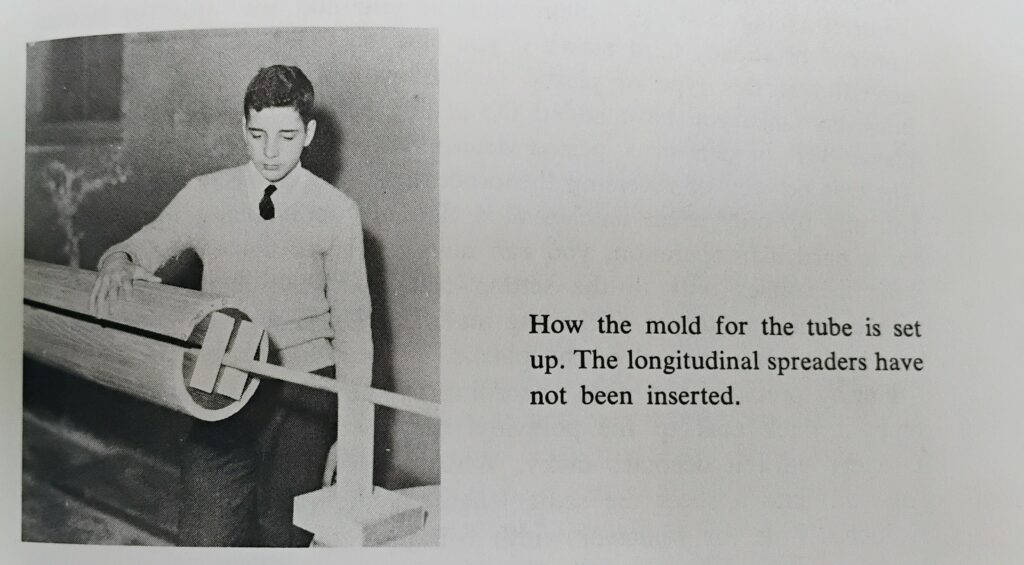
With images like the one below on page 173, it certainly looks like the book came out in 1959. (Sorry, kid, you gotta wear a tie for this photoshoot.)
Thus, some of the book was updated between 1959 and 1984, but not the whole thing.
I would also not recommend following the 18 supposedly simple steps for silvering a mirror as given on pages 333 to 335. That process is probably best left to mirror coating professionals.
However, the advice on how to grind a mirror, how make a pitch lap, and how to polish and figure a mirror had not really changed in the intervening years (and to the year 2025), so that section of the book still seems relevant.
Overall, if you want to grind, polish, and figure your own telescope mirror, then this book might provide some good advice for you.
Here are some books that I did not quite read 100%.
Eat, poop, die: How animals make our world was interesting, but I could not quite make it past page 110. I learned that collecting whale poop is really difficult. A short description is it “reveals how ecosystems are sculpted and sustained by animals eating, pooping, and dying-and how these fundamental functions could help save us from climate catastrophe.”
I thumbed my way through most of Engineering, design, and construction of portable Newtonian telescopes by Albert Highe, but I did not read it deeply. The author appeared to have some physical disabilities, and that limited him to making telescopes that had less weight for each part of his telescopes. Some of the designs that he covered were well thought out. He made two telescopes of 16 and 20 inches, and they were very light weight. He also covered some different designs that could be used for telescopes in the smaller 8 to 12 inch categories. All of those telescopes used struts of some sort. I got the book because someone in Cloudy Nights wanted to see the engineering data in a mini-CD that was in the back of the book.
I own the book The Pencil: A history of design and circumstance. I’ve got the 1989/1990 hardback version. I had read one of his other books on the Evolution of useful things, so I knew what I was getting myself into. He loves delving into detail and minutiae. In this one, I am stuck at page 86, so we will see if I ever dig deeper in this 434 page tome.
Years ago, I found this book, The Pencil perfect: The untold story of a cultural icon by Caroline Weaver, to be a little more engaging.
Even though this came out 19 years ago, it was still interesting to see what kind of tips and tricks I might be able to glean from the 65 hacks that they provide. The book is from O’ Reilly, and while they typically have computer based books, they delved into other technology topics, since they know that they have geeky readers.
Some of the hacks that I found most interesting were:
#9 on choosing the best telescope was quite lengthy. It was about 29 pages. Most of the other hacks are a lot shorter. They do a good job of covering the basics, but they steer people away from apo refractors.
#11 covers eyesight and vision. I don’t think I’ve previously learned about the chemistry of the rods and cones in the eyeball. I did not know that there are L, M, and S cones. I thought all cones were the same.
The section on eyepieces at #49 was just ok, and they seemed focused on Tele Vue and Pentax eyepieces to consider. Celestron and Meade were mentioned as well as some other makers, such as Orion, University Optics, and Vixen. They skipped other makers such as Baader, Brandon, RKE, and others. I guess Explore Scientific was not around yet – the company formed in 2008.
The review of 1x finders was good at #53. I will have to see if I can find a Rigel QuikFinder.
I did not like that he only called the Moon — Luna. I’m sure that was done to not confuse Earth’s Moon with other moons of the solar system. Still, it was a little jarring. It was also a little weird to have the authors use the term binocular for a single instrument instead of binoculars or let alone the phrase — a pair of binoculars. Really? We all know that a pair of pants is a single garment that one wears. It is not a pant. One wears pants, or a pair of pants.
End rant. The book is still a useful read 19 years after first publication.